AWS Cloud Computing
AWS Tutorial: What is Cloud Computing?
Welcome to the first core lesson of our AWS Tutorial. Before diving into Amazon Web Services specifically, it is essential to understand the foundational concept behind modern technology: Cloud Computing.
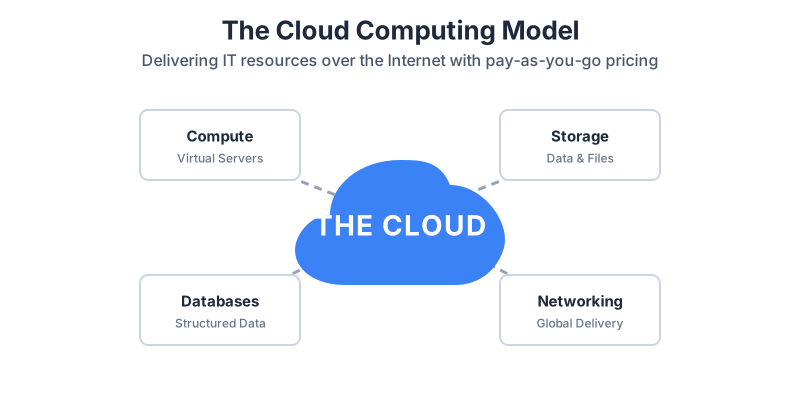
What is Cloud Computing?
In simple terms, Cloud Computing is the delivery of computing services—including servers, storage, databases, networking, software, and analytics—over the Internet (the "cloud").
Instead of buying, owning, and maintaining physical data centers and servers, you can access technology services on an as-needed basis from a cloud provider like Amazon Web Services (AWS).
Why Learn Cloud Computing?
If you are wondering why you should dedicate time to learning about the cloud in this tutorial, here are the major benefits that make it the industry standard:
- Cost Savings (Pay-as-you-go): You trade massive capital expenses (buying hardware) for variable expenses (paying only for what you consume). You don't have to pay for servers when they are turned off.
- Massive Elasticity: Stop guessing your capacity needs. You can scale your resources up or down instantly based on user demand, avoiding crashes during traffic spikes.
- Speed and Agility: Spin up new servers and IT resources in minutes with a few clicks, instead of waiting weeks for an IT team to rack and stack hardware.
- Global Reach: Deploy your applications in multiple regions around the world effortlessly to provide lower latency to your international customers.
- High Availability & Security: Cloud providers offer robust, redundant infrastructure that makes disaster recovery, data backup, and physical security much easier and far less expensive.
Deployment Models
There are three different kinds of deployment models:
- Cloud-based
- On-premises
- Hybrid
These models describe how compute resources are accessed: over the internet, locally, or using a combination of both.
Cloud-Based Deployment
Everything runs in the cloud. You can build new applications or migrate existing ones, choosing your level of control, from managing virtual servers to using fully managed services. Example: An application with virtual servers, databases, and networking components all hosted in the cloud.
On-Premises Deployment
Resources run in your own data center using virtualization and management tools. Also known as private cloud deployment. Modern virtualization helps maximize hardware utilization and simplifies resource management.
Hybrid Deployment
Connect cloud resources to on-premises infrastructure. Useful when handling sensitive data or meeting specific regulatory requirements.
Tutorial Overview: Cloud Service Models
In upcoming lessons, we will explore these models in depth, but as a quick overview, cloud computing services generally fall into three main categories. Understanding these is the first step to mastering AWS.
- IaaS (Infrastructure as a Service): The most flexible category. You rent basic IT infrastructure—servers, virtual machines (VMs), storage, and networks—on a pay-as-you-go basis. Example: AWS EC2.
- PaaS (Platform as a Service): Provides an on-demand environment for developers to build, test, and manage software applications without worrying about underlying infrastructure like operating systems or patching. Example: AWS Elastic Beanstalk.
- SaaS (Software as a Service): A method for delivering software applications over the Internet, on-demand, and typically on a subscription basis. You just use the software; the provider handles all the hosting and maintenance. Example: Gmail, Dropbox.
How AWS Fits In
Amazon Web Services (AWS) is the world's most comprehensive and broadly adopted cloud platform. While the concepts of IaaS, PaaS, and SaaS apply to any cloud provider (like Google Cloud or Microsoft Azure), AWS pioneered the modern public cloud infrastructure market. It currently offers over 200 fully featured services from data centers globally, powering everything from small startups to the largest enterprises.
Key Takeaways
- Cloud computing means renting computing power and storage over the Internet rather than owning it locally.
- It provides unparalleled agility, scalability, and cost-efficiency.
- Deployments can be Cloud-Based, On-Premises, or Hybrid.
- AWS is the leading provider of cloud computing services globally.
Now that you know what the cloud is, let's explore how AWS physically builds its cloud across the globe in the next section!
Exercise
?Which cloud service model provides the highest level of flexibility and management control over your IT resources, similar to traditional on-premises data centers?