AWS Lambda
AWS Tutorial: Amazon Web Services Lambda
Welcome to the AWS Lambda lesson. AWS Lambda is the flagship service that powers the Serverless revolution on the Amazon cloud.
Why Learn AWS Lambda?
If you are building modern applications, microservices, or data processing pipelines on AWS, Lambda is going to be your primary compute engine. It natively integrates with over 200 AWS services, making it the most powerful glue holding cloud architectures together.
Tutorial Overview
In this tutorial, you will learn:
- What AWS Lambda is.
- How Event-Driven computing works.
- Common use cases for Lambda functions.
What is AWS Lambda?
AWS Lambda is an event-driven, serverless computing service that lets you run code for virtually any type of application or backend service without provisioning or managing servers. You author your code in languages like Python, Node.js, Java, Go, or C#, package it up, and upload it to Lambda.
Event-Driven Computing
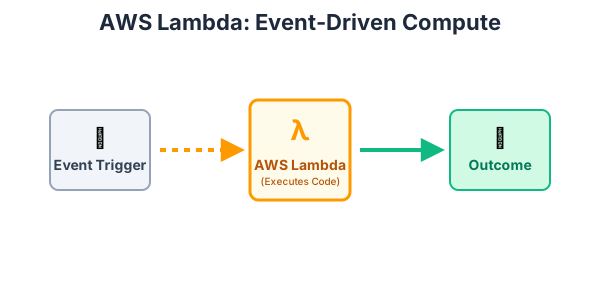
Lambda functions do not run continuously. They sit idle until an Event triggers them. Common triggers include:
- An HTTP Request: A user clicks a button on your website, triggering API Gateway to fire Lambda to fetch data.
- A File Upload: A user uploads an image to an Amazon S3 bucket. S3 triggers Lambda to quickly compress the image.
- A Schedule: Amazon EventBridge triggers Lambda every morning at 9:00 AM to generate a daily report.
Execution Limits
Lambda is designed for fast, short-lived tasks. The absolute maximum execution time for a single Lambda function is 15 minutes. If your code takes longer than that to process, you must use a container (like AWS Fargate) or an EC2 instance instead!
Exercise
?What is the maximum allowed execution time for an AWS Lambda function before it automatically times out?