AWS Availability Zones
AWS Tutorial: Availability Zones Explained
Welcome to the Availability Zones (AZs) lesson. Inside every AWS Region, you will find multiple, highly isolated Availability Zones.
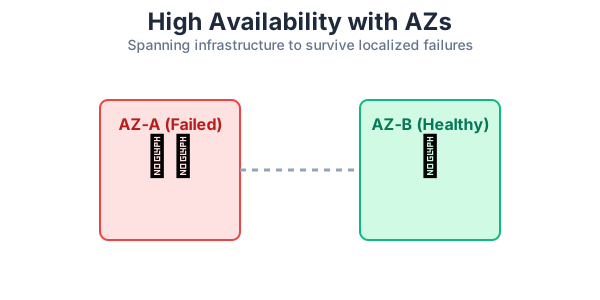
Why Learn About Availability Zones?
Understanding AZs is the secret to building applications that never go down. If you put all your servers in one AZ and that building loses power, your app crashes. By spanning multiple AZs, you achieve true High Availability.
Tutorial Overview
In this tutorial, you will learn:
- What defines an Availability Zone.
- How AZs provide Fault Tolerance.
- How AZs communicate with each other.
The Anatomy of an AZ
An Availability Zone (AZ) is one or more discrete data centers with redundant power, networking, and connectivity. They are housed in separate, physically distinct facilities within a Region (usually miles apart).
Fault Tolerance and High Availability
Because AZs are physically separated, they are isolated from localized disasters like floods, fires, or power grid failures. If a catastrophic event takes out AZ-A, the independent data centers in AZ-B remain completely unaffected.
AZ Connectivity
Despite being physically miles apart to ensure fault tolerance, all AZs within a single Region are interconnected using dedicated, highly encrypted, low-latency, high-throughput fiber-optic networking. This allows your database in AZ-A to instantly sync with its backup in AZ-B.
Exercise
?Why are Availability Zones physically separated by several miles within a Region?