AWS EC2 Instance Types
AWS Tutorial: Amazon EC2 Instance Types
Welcome to the Amazon EC2 Instance Types lesson. Not all applications require the same amount of CPU, memory, or storage. AWS offers various instance types to match your workload perfectly.
Why Learn EC2 Instance Types?
Selecting the right instance type optimizes both performance and cost. If you choose an instance that is too large, you overpay. If you choose one that is too small, your application crashes under load. Understanding these types is crucial for cost-effective cloud architecture.
Tutorial Overview
In this tutorial, you will discover the five primary families of EC2 instance types:
- General Purpose
- Compute Optimized
- Memory Optimized
- Storage Optimized
- Accelerated Computing
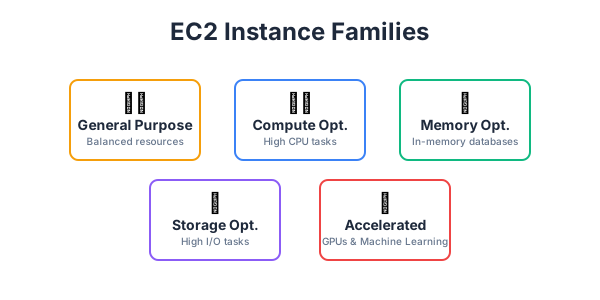
The EC2 Instance Families
- General Purpose: Provide a balance of compute, memory, and networking resources. They are ideal for a variety of workloads, such as web servers and code repositories. (e.g.,
t2.micro,m5.large) - Compute Optimized: Ideal for compute-bound applications that benefit from high-performance processors, such as batch processing, media transcoding, and high-performance web servers. (e.g.,
c5.large) - Memory Optimized: Designed to deliver fast performance for workloads that process large data sets in memory, like in-memory databases and real-time big data analytics. (e.g.,
r5.large) - Storage Optimized: Designed for workloads that require high, sequential read and write access to very large data sets on local storage, such as data warehousing and distributed file systems. (e.g.,
i3.large) - Accelerated Computing: Use hardware accelerators, or co-processors, to perform functions (like graphics processing or data pattern matching) more efficiently than is possible in software running on CPUs. (e.g.,
p3.2xlarge)
Exercise
?Which EC2 instance type is best suited for an in-memory database?