AWS Core Pricing Concepts
AWS Tutorial: AWS Pricing Concepts
Welcome to the Pricing Concepts lesson. AWS provides incredibly flexible pricing, allowing companies of all sizes to pay only for what they need.
Why Learn Pricing Concepts?
Understanding the fundamental laws of AWS pricing allows you to architect cost-optimized systems. If you design an application that unnecessarily transfers data across regions, you will incur massive bandwidth fees!
Tutorial Overview
In this tutorial, you will learn the three fundamental drivers of cost in AWS:
- Compute
- Storage
- Data Transfer
The 3 Fundamental Drivers of Cost
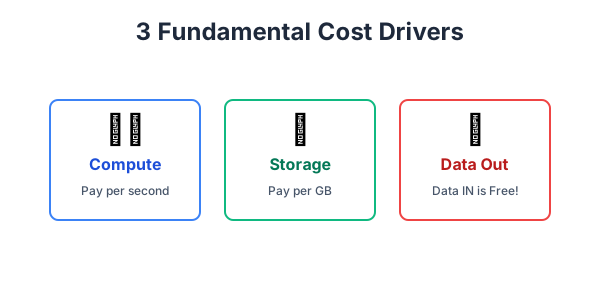
Across the 200+ services in AWS, almost all of your costs will boil down to three things:
- Compute: You pay for compute time (e.g., paying per second for EC2 instances or per millisecond for Lambda).
- Storage: You pay for the amount of data you store in the cloud (e.g., paying per Gigabyte stored in S3 or EBS).
- Outbound Data Transfer: Data transferring INTO AWS is generally always free! However, you pay for data transferring OUT of AWS (to the internet or to different AWS regions).
The 3 Pricing Principles
- Pay as you go: Pay only for what you use, with no minimum commitments.
- Pay less when you reserve: Get massive discounts (up to 72%) when you commit to a 1 or 3-year term for compute capacity (Reserved Instances).
- Pay less by using more: AWS uses volume-based discounts. The more S3 storage you use, the less you pay per Gigabyte.
Exercise
?Regarding Data Transfer costs in AWS, which statement is generally true?