AWS Containers
AWS Tutorial: Introduction to Containers
Welcome to the AWS Containers lesson. While Serverless functions (like AWS Lambda) are fantastic for new event-driven microservices, many legacy applications and complex service architectures are built and deployed using Containers (like Docker).
Why Learn About Containers on AWS?
Containers are widely recognized as the industry standard for packaging and deploying modern software. They ensure your application runs identically on your local laptop, a testing server, and the production AWS cloud. Knowing how to securely host and scale them in AWS is a critical skill for DevOps engineers and modern software developers.
Tutorial Overview
In this tutorial, you will learn:
- What a Container actually is.
- How containers fundamentally differ from Virtual Machines (EC2).
- The primary container orchestration services available in AWS.
What is a Container?
A container is a highly standardized unit of software that safely packages up code and all its required dependencies (libraries, frameworks, and configuration files) so the application runs quickly, reliably, and consistently from one computing environment to another. Docker is by far the most widely used containerization platform in the world today.
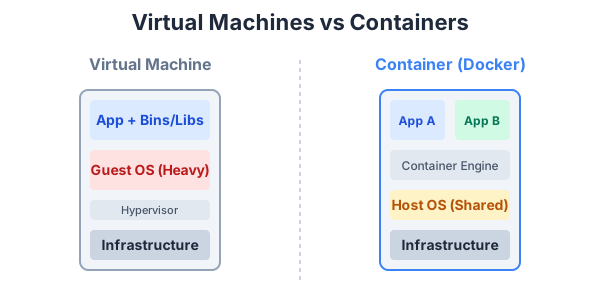
Containers vs. Virtual Machines
- Virtual Machine (EC2): Includes the application, its required dependencies, and a massive full guest Operating System. They are very heavy, can take several minutes to boot up, and consume significant computing resources.
- Container: Includes the application and its dependencies, but completely shares the underlying host OS kernel with other containers. They are incredibly lightweight, take milliseconds to boot up, and allow you to efficiently pack dozens of isolated containers onto a single EC2 server.
AWS Container Services
When you have hundreds of individual containers running in production, you need an automated way to manage, scale, and monitor them. This is called "Container Orchestration". AWS provides two primary orchestration tools for this task:
- Amazon ECS (Elastic Container Service): An AWS-native, highly scalable, and fast container management service. It is deeply integrated with the rest of the AWS ecosystem and is generally considered the easiest to learn and use.
- Amazon EKS (Elastic Kubernetes Service): A robust managed service that allows you to run Kubernetes (an open-source orchestrator originally built by Google) on AWS without needing to physically install and operate your own complicated Kubernetes control plane.
Exercise
?What technical architecture feature makes a Container much more lightweight and significantly faster to boot than a traditional Virtual Machine?