Selection Sort
Selection Sort Algorithm
Key Takeaways: Selection Sort works by repeatedly finding the minimum element from the unsorted part of the array and putting it at the beginning. It is simple to understand but inefficient for large lists.
In the previous tutorial, we learned about Bubble Sort. Now, let's look at another classic algorithm: Selection Sort.
While Bubble Sort swaps adjacent elements constantly, Selection Sort minimizes swaps by searching for the absolute smallest element first.
1. How Does Selection Sort Work?
Selection Sort divides the array into two parts:
- The sorted part at the front.
- The unsorted part at the back.
Initially, the sorted part is empty, and the unsorted part is the entire array.
The algorithm works like this:
- Look through the entire unsorted part to find the smallest number.
- Swap that smallest number with the first number of the unsorted part.
- Move the boundary one step to the right.
- Repeat until the whole array is sorted!
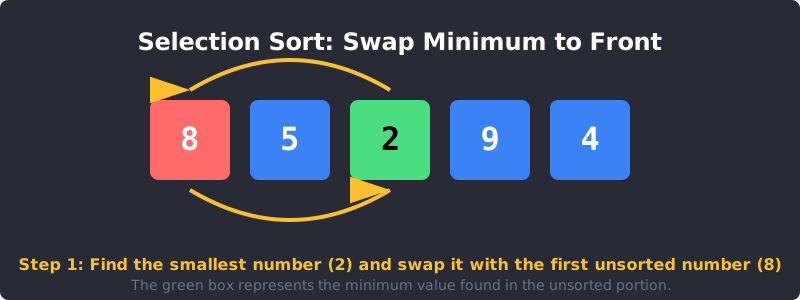
Selection Sort: Scan for the smallest item, then swap it into its correct place.
2. A Step-by-Step Example
Let's sort an array of numbers from lowest to highest: [8, 5, 2, 9, 4]
Pass 1:
- Search the whole array:
[8, 5, 2, 9, 4]. - The minimum value is
2. - Swap
2with the first element8. - Array is now:
[2, 5, 8, 9, 4]. The number2is sorted.
Pass 2:
- Search the remaining unsorted array:
[5, 8, 9, 4]. - The minimum value is
4. - Swap
4with the first unsorted element5. - Array is now:
[2, 4, 8, 9, 5]. The numbers2, 4are sorted.
Pass 3:
- Search the remaining unsorted array:
[8, 9, 5]. - The minimum value is
5. - Swap
5with8. - Array is now:
[2, 4, 5, 9, 8].
Pass 4:
- Search the remaining unsorted array:
[9, 8]. - The minimum value is
8. - Swap
8with9. - Array is now completely sorted:
[2, 4, 5, 8, 9].
3. Selection Sort Code Example
Let's write the Selection Sort algorithm in Python.
Selection Sort in Python
def selection_sort(arr): n = len(arr) # Traverse through all array elements for i in range(n): # Find the minimum element in remaining unsorted array min_idx = i for j in range(i + 1, n): if arr[j] < arr[min_idx]: min_idx = j # Swap the found minimum element with the first element arr[i], arr[min_idx] = arr[min_idx], arr[i] return arrnumbers = [8, 5, 2, 9, 4] print("Original:", numbers) print("Sorted:", selection_sort(numbers))
4. Time Complexity
- Time Complexity:
O(n²). - Space Complexity:
O(1). It sorts the array in-place, meaning it doesn't require any extra memory.
Time Complexity Calculation
Why is it exactly O(n²)? Let's break down the math:
- For an array of size
n, the first pass checksn-1elements to find the minimum. - The second pass checks
n-2elements. - The third pass checks
n-3elements, and so on, down to1operation.
If we add all those comparisons together: (n-1) + (n-2) + ... + 1.
In mathematics, the sum of the first n-1 integers equals n * (n - 1) / 2.
When we use Big O Notation, we ignore constants (like / 2) and smaller terms (like - n), leaving us with the dominant term: O(n²). Because of this, Selection Sort always scans the entire unsorted portion of the array, even if the array is already perfectly sorted!
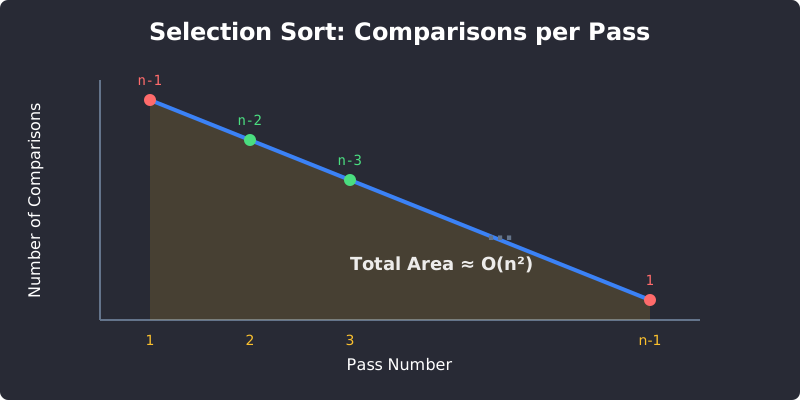
The number of comparisons decreases linearly, forming a triangle. The total area (total operations) is proportional to n² / 2.
Although it has the same O(n²) time complexity as Bubble Sort, Selection Sort is generally a little bit faster because it performs far fewer memory swaps!
Exercise 1 of 1
?In Selection Sort, what happens after the algorithm finds the smallest element in the unsorted portion?