Post-Order Traversal
Post-Order Traversal
Key Takeaways: Post-Order Traversal is the final major Depth-First Search (DFS) algorithm for trees. The visiting order is strictly: Left, Right, Root. It is commonly used for safely deleting a tree from memory.
We have covered Pre-Order (Root first) and In-Order (Root in the middle).
Now, it is time to explore Post-Order Traversal, where the Root is visited absolutely last!
1. What is Post-Order Traversal?
Tree traversal means visiting every single node in the tree exactly one time.
Because trees are hierarchical, we need a specific, repeatable path to follow.
Post-Order Traversal follows this strict path:
- Left: First, recursively visit the entire Left subtree.
- Right: Second, recursively visit the entire Right subtree.
- Root: Third, visit the current node (the Root of the subtree).
The prefix "Post" helps you remember that the Root is visited after both of its children have been fully processed!
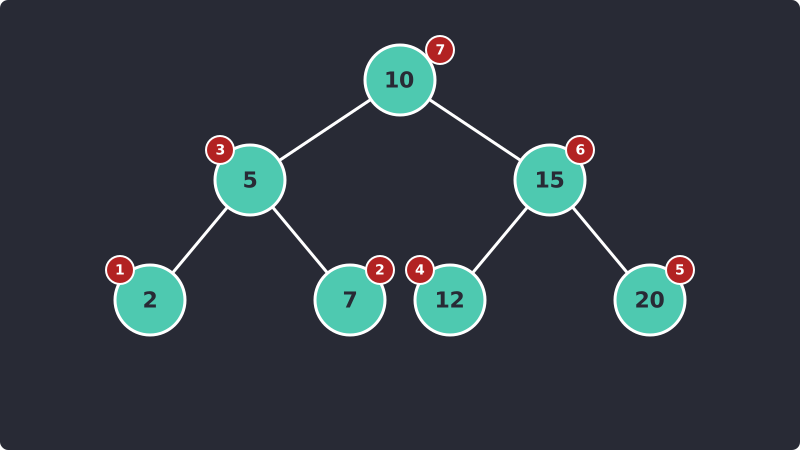
Post-Order Traversal: Children are always processed before their parents.
2. A Step-by-Step Example
Let's look at the tree in the diagram above and trace the exact execution path.
Assume we have a Binary Tree with a Root of 10, a Left Child of 5, and a Right Child of 15.
The 5 has its own children: 2 (Left) and 7 (Right).
The 15 has its own children: 12 (Left) and 20 (Right).
Step 1: Dive to the Bottom Left
- Start at the absolute Root: 10.
- Rule 1 says: Go Left. We move to 5.
- Rule 1 says: Go Left. We move to 2.
- Rule 1 says: Go Left. Node 2 has no left child!
Step 2: Processing the First Leaf
- We are at 2. Left is done.
- Rule 2 says: Go Right. No right child!
- Rule 3 says: Visit the Root. We print
2. - Node 2 is fully processed. We move back up to 5.
Step 3: The Right Child of 5
- We are back at 5. Its Left child is fully processed.
- Rule 2 says: Go Right. We move to 7.
Step 4: Processing the Second Leaf
- We are at 7. Go Left? None.
- Go Right? None.
- Rule 3 says: Visit the Root. We print
7. - Node 7 is done. We move back up to 5.
Step 5: Processing Node 5
- We are back at 5. Left (2) and Right (7) are both fully processed.
- Rule 3 says: Visit the Root. We print
5. - Node 5 is done. We move back up to 10.
Step 6: Diving Down the Right Side
- We are back at 10. Its entire Left subtree is fully processed.
- Rule 2 says: Go Right. We move to 15.
- Rule 1 says: Go Left. We move to 12.
Step 7: Processing the Right Leaves
- At 12, no Left and no Right child. Visit Root: print
12. Move up to 15. - At 15, Left is done. Rule 2: Go Right. We move to 20.
- At 20, no Left and no Right child. Visit Root: print
20. Move up to 15.
Step 8: Finishing the Tree
- At 15, Left and Right are done. Visit Root: print
15. Move up to 10. - At 10, Left and Right are done. Visit Root: print
10.
Final Output: 2, 7, 5, 12, 20, 15, 10
3. Why Use Post-Order Traversal?
Every traversal has a specific superpower. What is Post-Order good for?
1. Deleting a Tree Safely If you want to delete an entire tree from memory, you cannot delete a parent node first, or you will lose the pointers to its children! Post-Order traversal guarantees that you will delete the Left child, then the Right child, and finally the Parent. It is the safest way to dismantle a tree.
2. Postfix Notation (Reverse Polish Notation)
In mathematical expression trees, Post-Order traversal generates Postfix Expressions (like A B +). This is how many advanced calculators and computer systems evaluate math under the hood!
3. Calculating Directory Sizes If you want to know the total size of a folder on your computer, the OS must first calculate the size of every file and sub-folder inside it before it can tell you the total size of the parent folder. This is a classic Post-Order operation.
4. Code Example (Python)
Let's write the code for Post-Order Traversal.
Once again, we use Recursion. Notice how the print() statement is placed at the very end of the function, after both recursive calls!
Post-Order Traversal Implementation
# 1. Create the Node Class class Node: def __init__(self, data): self.left = None self.right = None self.data = data# 2. Define the Post-Order function def postorder_traversal(node): # Base case: If the node is None, stop! if node is not None: # 1. Traverse the Left Subtree postorder_traversal(node.left) # 2. Traverse the Right Subtree postorder_traversal(node.right) # 3. Visit the Root (Print it last!) print(node.data, end=" ")
# 3. Build the Binary Tree root = Node(10) root.left = Node(5) root.right = Node(15)
root.left.left = Node(2) root.left.right = Node(7)
root.right.left = Node(12) root.right.right = Node(20)
# 4. Run the Algorithm print("Post-Order Output:") postorder_traversal(root)
5. Time and Space Complexity
- Time Complexity:
O(n). Every single node in the tree is visited exactly once. The amount of time taken scales linearly with the number of items. - Space Complexity:
O(h). Wherehis the maximum height of the tree. This extra space is required to maintain the recursive Call Stack.
Exercise 1 of 2
?What is the exact execution order for a Post-Order Traversal?
Exercise 2 of 2
?Why is Post-Order Traversal considered the best algorithm for safely deleting a tree from memory?