Counting Sort
Counting Sort Algorithm
Key Takeaways: Counting Sort is a "non-comparison" sorting algorithm. Instead of comparing numbers to each other, it simply counts how many times each number appears. It is incredibly fast but only works well for whole numbers within a specific range.
All the algorithms we have learned so far (Bubble, Selection, Insertion, Quick) are Comparison Sorts. They work by constantly asking: "Is number A bigger than number B?"
Counting Sort does something completely different. It doesn't compare elements at all!
1. How Does Counting Sort Work?
Counting Sort works by keeping a tally of how many times each number appears in the array.
Real-Life Analogy
Imagine you have a big bucket of red, blue, and green balls. You want to line them up in order: all red, then all blue, then all green.
Instead of comparing balls to each other, you just count them:
- Red: 4
- Blue: 2
- Green: 3
Now, you just place 4 red balls in a row, followed by 2 blue balls, followed by 3 green balls. You are done! That is exactly how Counting Sort works with numbers.
2. The Step-by-Step Process
Let's say we want to sort this array: [4, 2, 2, 5, 3, 3]
Step 1: Find the Maximum Value
The largest number in our array is 5.
Step 2: Create a Count Array
We create a new array filled with zeros, from index 0 up to our max value 5.
[0, 0, 0, 0, 0, 0] (These represent the counts for numbers 0, 1, 2, 3, 4, 5).
Step 3: Count the Frequencies We look at our original array and tally up the numbers.
- We have zero
0s and zero1s. - We have two
2s. - We have two
3s. - We have one
4. - We have one
5.
Our Count Array now looks like this:
Index: [ 0, 1, 2, 3, 4, 5 ]
Count: [ 0, 0, 2, 2, 1, 1 ]
Step 4: Rebuild the Sorted Array We simply read our Count Array from left to right to build the final sorted array.
- Write
2twice. - Write
3twice. - Write
4once. - Write
5once.
Final Sorted Array: [2, 2, 3, 3, 4, 5].
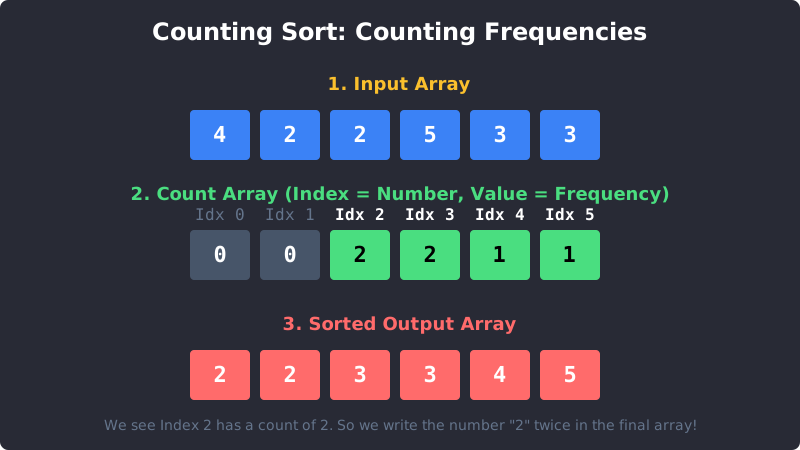
Counting Sort: Tallying the frequencies and writing them out in order.
3. Counting Sort Code Example
Here is a simple Python implementation of Counting Sort.
Notice that there are no if arr[i] > arr[j] comparisons!
Counting Sort in Python
def counting_sort(arr): # 1. Find the maximum value to know the size of the count array max_val = max(arr) # 2. Create a count array of size max_val + 1, filled with 0s count = [0] * (max_val + 1) # 3. Store the count of each element for num in arr: count[num] += 1 # 4. Rebuild the sorted array sorted_arr = [] for i in range(len(count)): # Append the index 'i' to our result 'count[i]' times for j in range(count[i]): sorted_arr.append(i) return sorted_arrnumbers = [4, 2, 2, 5, 3, 3] print("Original:", numbers) print("Sorted:", counting_sort(numbers))
4. Time and Space Complexity
- Time Complexity:
O(n + k). Wherenis the number of elements in the input array, andkis the maximum value. It runs in linear time, which is phenomenally fast! - Space Complexity:
O(k). We have to create a new "Count Array" up to the maximum value.
The Big Weakness
Why don't we use Counting Sort for everything? Because of the Space Complexity.
If you want to sort an array like this: [2, 1, 1000000], the algorithm will create a count array with 1,000,000 empty slots just to sort three numbers! That is a massive waste of computer memory.
Therefore, Counting Sort is only useful when the range of numbers is small.