Kruskal's Algorithm
Minimum Spanning Tree: Kruskal's Algorithm
Key Takeaways: Kruskal's Algorithm is a greedy algorithm used to find the Minimum Spanning Tree (MST) of a graph. It works by sorting all the edges from lightest to heaviest and adding them one by one, skipping any edges that would create a cycle.
In previous tutorials, we explored the concept of a Minimum Spanning Tree (MST) and how to build one using Prim's Algorithm. While Prim's algorithm grows a tree outward from a single starting point, Kruskal's Algorithm takes a completely different, global approach.
Kruskal's algorithm doesn't care about starting points or connected boundaries. It simply looks at the entire map, grabs the absolute shortest available road anywhere, and builds the network piece by piece.
If you are building a vast fiber-optic network across a country, Kruskal's ensures you are using the absolute least amount of cable possible.
1. How Does Kruskal's Algorithm Work?
Kruskal's algorithm is one of the most elegant Greedy Algorithms in computer science. At every single step, it makes the "greediest" or cheapest possible choice, which mathematically leads to the optimal global solution.
The Three-Step Process
- Sort: Take every single edge in the entire graph and sort them in ascending order based on their weight (from cheapest to most expensive).
- Iterate: Go down your sorted list of edges one by one.
- Check for Cycles: If adding the edge connects two isolated groups of nodes without creating a closed loop (a cycle), add it to your MST! If it creates a loop, throw it in the trash and move to the next edge.
The algorithm stops as soon as the MST contains exactly V - 1 edges (where V is the total number of vertices). A valid spanning tree connecting V nodes will always have exactly V - 1 edges.
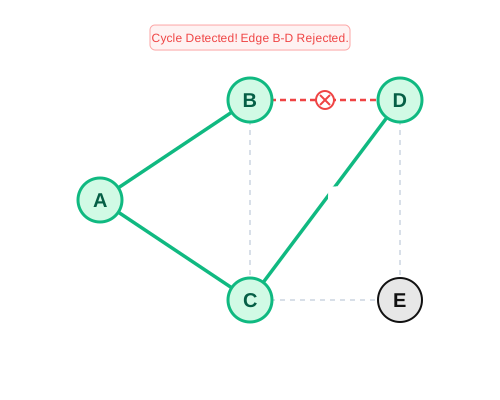
Kruskal's Algorithm: Edges are added by weight. The red dashed line (weight 4) is rejected because it forms a cycle between A, B, C, and D.
2. The Secret Weapon: Disjoint Set (Union-Find)
The biggest challenge in Kruskal's algorithm is Step 3: How do we quickly know if an edge will create a cycle?
If we run a Depth-First Search (DFS) every single time we want to add an edge, our algorithm will become incredibly slow. Instead, we use a specialized data structure called a Disjoint Set (also known as a Union-Find data structure).
A Disjoint Set keeps track of which "group" or "component" a node belongs to.
It has two main operations:
- Find(node): Instantly tells you which group a node belongs to.
- Union(node1, node2): Merges two separate groups into one single group.
How it prevents cycles:
Before Kruskal adds an edge between Node A and Node B, it calls Find(A) and Find(B).
- If they return different groups, they are safe to connect! We then
Union(A, B). - If they return the same group, it means they are already connected somewhere else in the tree. Adding this edge would create a cycle, so we reject it!
3. A Manual Run-Through
Let's trace Kruskal's algorithm on a graph with nodes A, B, C, D, E to see how the sorting and cycle detection work together.
Our Unsorted Edges:
A-B (2)A-C (3)B-C (5)B-D (4)C-D (1)C-E (6)D-E (7)
Step 1: Sort the Edges We organize the edges from lowest to highest weight:
C-D (1)A-B (2)A-C (3)B-D (4)B-C (5)C-E (6)D-E (7)
Step 2: Iterate and Build
- Pop C-D (1):
Find(C)andFind(D)are different. Safe to add! We Union them. Our forest has[C-D]. - Pop A-B (2):
Find(A)andFind(B)are different. Safe to add! We Union them. Our forest has[C-D]and[A-B]. (Notice we currently have two disconnected mini-trees). - Pop A-C (3):
Find(A)andFind(C)are different. Safe to add! We Union them. This edge connects our two mini-trees together! All nodes A, B, C, D are now in one big group. - Pop B-D (4):
Find(B)andFind(D)return the same group (they are already connected via A and C). Reject this edge to avoid a cycle! - Pop B-C (5):
Find(B)andFind(C)return the same group. Reject this edge! - Pop C-E (6):
Find(C)andFind(E)are different. Safe to add! Node E is now connected. - (Optimization: We now have exactly
V - 1(4) edges, so we can stop early!)
Result: The final MST edges are C-D (1), A-B (2), A-C (3), and C-E (6). Total cost: 12.
4. Implementation of Kruskal's Algorithm
Below is the complete Python implementation. We will first build a highly optimized DisjointSet class that uses Path Compression and Union by Rank to keep the Find and Union operations running in near-constant O(1) time.
Kruskal's Algorithm (Python)
class DisjointSet: def __init__(self, vertices): # Initially, every node is its own parent (its own group) self.parent = {v: v for v in vertices} self.rank = {v: 0 for v in vertices} def find(self, item): # Path compression: Attach nodes directly to the root if self.parent[item] == item: return item self.parent[item] = self.find(self.parent[item]) return self.parent[item] def union(self, set1, set2): root1 = self.find(set1) root2 = self.find(set2) if root1 != root2: # Union by Rank: Keep the tree shallow by attaching # the smaller tree under the taller tree if self.rank[root1] > self.rank[root2]: self.parent[root2] = root1 elif self.rank[root1] < self.rank[root2]: self.parent[root1] = root2 else: self.parent[root2] = root1 self.rank[root1] += 1def kruskals_algorithm(vertices, edges): mst = [] total_cost = 0 # 1. Sort all edges by their weight (index 2 of the tuple) edges.sort(key=lambda x: x[2]) ds = DisjointSet(vertices) # 2. Iterate through the sorted edges for u, v, weight in edges: # 3. Check for cycles using Find if ds.find(u) != ds.find(v): # Safe to add! ds.union(u, v) mst.append((u, v, weight)) total_cost += weight # Optimization: Stop early if we have V-1 edges if len(mst) == len(vertices) - 1: break return mst, total_cost
# Define the Graph vertices = ['A', 'B', 'C', 'D'] edges = [ ('A', 'D', 5), ('A', 'B', 1), ('C', 'D', 2), ('B', 'C', 4), ('A', 'C', 3) ]
mst_result, min_cost = kruskals_algorithm(vertices, edges) print("Edges in MST:", mst_result) print("Total Cost:", min_cost)
5. Complexity Analysis
Kruskal's algorithm performance is heavily tied to the fact that it must sort the edges before it can do anything else.
- Time Complexity:
O(E log E)orO(E log V). Sorting all the edges takesO(E log E)time. The Disjoint Set operations take almostO(1)time thanks to path compression. Thus, the sorting dominates the runtime. - Space Complexity:
O(V + E). We needO(E)space to store the sorted edges, andO(V)space to maintain the Disjoint Set parent and rank arrays.
When to Use Kruskal's vs. Prim's?
| Algorithm | Best Use Case | Why? |
|---|---|---|
| Kruskal's Algorithm | Sparse Graphs (Very few edges) | Sorting fewer edges is incredibly fast. Kruskal jumps around the map effortlessly to build isolated forests before connecting them. |
| Prim's Algorithm | Dense Graphs (Massive numbers of edges) | Prim's is bounded by vertices. It avoids sorting millions of edges globally and just picks the best local edge organically using a Min-Heap. |
Exercise 1 of 2
?Which specialized data structure allows Kruskal's Algorithm to check for cycles in near-constant O(1) time?
Exercise 2 of 2
?What is the very first step Kruskal's algorithm takes before it begins adding edges to the tree?