Binary Search Trees
Binary Search Trees (BST)
Key Takeaways: A Binary Search Tree (BST) is a special type of Binary Tree. It automatically keeps data sorted by ensuring that all values smaller than a node go to its Left, and all values larger go to its Right.
In previous tutorials, we learned about basic Binary Trees. A regular Binary Tree can hold data in any random order.
However, if we want to find a specific item in a random tree, we have to search every single node. This is slow!
To fix this, Computer Scientists created the Binary Search Tree.
1. The Rules of a BST
A Binary Search Tree is just a normal Binary Tree that strictly follows one golden rule.
For every single node in the tree:
- All values in its Left Subtree must be smaller than the node's value.
- All values in its Right Subtree must be larger than the node's value.
- (Usually, duplicate values are not allowed, or they are strictly placed on one specific side).
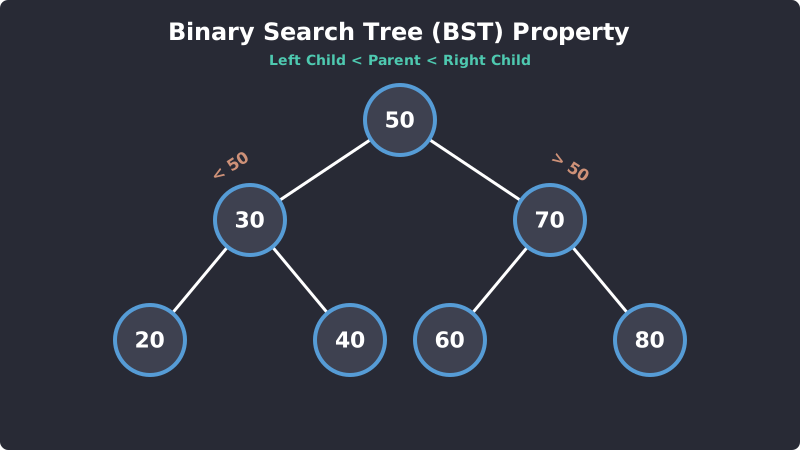
Binary Search Tree: Left is always smaller, Right is always larger.
2. Why are BSTs so fast?
A BST works exactly like the Binary Search algorithm we learned for Arrays.
Imagine you are looking for the number 60 in the tree above.
- You start at the Root:
50. - Is
60greater than or less than50? It is greater! - You instantly ignore the entire left half of the tree. You move Right to
70. - Is
60greater than or less than70? It is less! - You move Left and find
60!
With just two comparisons, we eliminated over half of the tree. This gives searching a blistering O(log n) time complexity!
3. BST Operations: Insertion
How do we build a Binary Search Tree? We insert nodes one by one, letting them "fall" into their correct places.
Let's insert 45 into the tree above:
- Start at
50.45is less than50, so go Left. - We are at
30.45is greater than30, so go Right. - We are at
40.45is greater than40, so go Right. - There is no node to the right of
40! We create a new node for45here.
4. BST Operations: Deletion
Deleting a node is the hardest operation in a BST because we have to keep the tree connected and sorted.
There are 3 specific cases for deletion:
Case 1: The node is a Leaf (No Children)
This is easy! If you want to delete 20, you just remove it. The tree remains perfectly valid.
Case 2: The node has exactly ONE Child
If you want to delete 70 (assuming it only had 60 as a child), you just delete 70 and connect its parent (50) directly to its child (60).
Case 3: The node has TWO Children
If you want to delete the Root (50), you can't just delete it, or the whole tree splits in half!
Instead, you find its In-Order Successor.
- The In-Order Successor is the smallest value in the Right subtree.
- You copy the Successor's value into the Root, and then delete the Successor.
5. Coding a BST (Python)
Let's look at how to implement the Node structure, Insert method, and Search method in Python.
BST: Insert and Search
# 1. Create the TreeNode Class class TreeNode: def __init__(self, key): self.left = None self.right = None self.val = key# 2. Insert Function def insert(root, key): # If tree is empty, return a new node if root is None: return TreeNode(key) # Otherwise, recurse down the tree if key < root.val: root.left = insert(root.left, key) elif key > root.val: root.right = insert(root.right, key) # Return the (unchanged) node pointer return root
# 3. Search Function def search(root, key): # Base Cases: root is null or key is present at root if root is None or root.val == key: return root # Key is greater than root's key, search Right if root.val < key: return search(root.right, key) # Key is smaller than root's key, search Left return search(root.left, key)
# Let's test it out! root = None root = insert(root, 50) insert(root, 30) insert(root, 20) insert(root, 40) insert(root, 70) insert(root, 60) insert(root, 80)
# Search for a value result = search(root, 60) if result: print("Found:", result.val) else: print("Value not found in BST.")
6. Time and Space Complexity
- Time Complexity (Average):
O(log n). Because we eliminate half of the tree with every step, searching, inserting, and deleting are exceptionally fast. - Time Complexity (Worst Case):
O(n). If you insert data that is already sorted (e.g., 10, 20, 30, 40), the tree just forms a straight line! It basically degrades into a slow Linked List. - Space Complexity:
O(n)to hold the nodes, plusO(h)for the recursive call stack (wherehis the tree's height).
Exercise 1 of 2
?What is the primary rule that makes a tree a Binary Search Tree (BST)?
Exercise 2 of 2
?What is the worst-case Time Complexity for searching in a completely unbalanced BST (a straight line)?