Merge Sort
Merge Sort Algorithm
Key Takeaways: Merge Sort is one of the most efficient sorting algorithms. It uses a "Divide and Conquer" approach, splitting the array in half until it cannot be split anymore, and then merging those pieces back together in sorted order.
Like Quick Sort, Merge Sort is extremely fast and is widely used in real-world programming. In fact, many programming languages (like Java) use a variation of Merge Sort for their built-in sorting functions!
Let's explore how it divides data to conquer massive sorting problems.
1. The Divide and Conquer Approach
Merge Sort literally cuts the problem in half over and over again.
The algorithm follows two main steps:
- Divide: Keep cutting the array in half until you are left with arrays that only have 1 element each. (An array with 1 element is already perfectly sorted!)
- Conquer (Merge): Pair up these 1-element arrays and merge them into a 2-element sorted array. Pair up the 2-element arrays into 4-element sorted arrays. Repeat until the whole array is rebuilt!
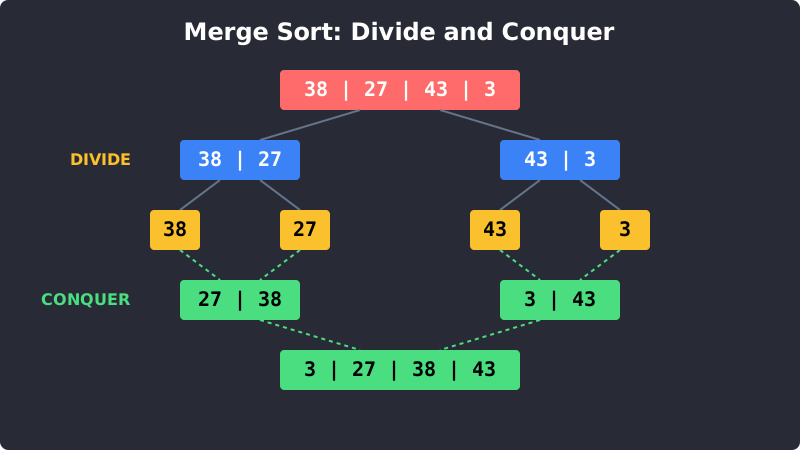
Merge Sort: Splitting down to single elements, then merging them back in perfect order.
2. A Step-by-Step Example
Let's trace how Merge Sort handles this array: [38, 27, 43, 3]
Phase 1: Divide (Splitting)
- Split in half:
[38, 27]and[43, 3]. - Split those in half:
[38],[27],[43],[3]. - We cannot split anymore. We now have four sorted arrays of length 1!
Phase 2: Conquer (Merging)
- Merge
[38]and[27]. Which is smaller?27. So they become[27, 38]. - Merge
[43]and[3]. Which is smaller?3. So they become[3, 43]. - Now we have two sorted arrays:
[27, 38]and[3, 43]. - Merge them together! Compare the first items:
27and3. The3wins. - Compare
27and43. The27wins. - Compare
38and43. The38wins. - Final sorted array:
[3, 27, 38, 43].
3. Merge Sort Code Example
Below is the Python implementation of Merge Sort. It uses Recursion (a function calling itself) to continuously split the array, and a helper loop to merge the arrays back together.
Merge Sort in Python
def merge_sort(arr): if len(arr) > 1: # Find the middle point mid = len(arr) // 2 # Divide the array elements left_half = arr[:mid] right_half = arr[mid:] # Recursively sort both halves merge_sort(left_half) merge_sort(right_half) # Conquer: Merge the sorted halves i = j = k = 0 # Compare elements from left and right halves while i < len(left_half) and j < len(right_half): if left_half[i] < right_half[j]: arr[k] = left_half[i] i += 1 else: arr[k] = right_half[j] j += 1 k += 1 # Check if any elements were left over while i < len(left_half): arr[k] = left_half[i] i += 1 k += 1 while j < len(right_half): arr[k] = right_half[j] j += 1 k += 1 return arrnumbers = [38, 27, 43, 3, 9, 82, 10] print("Original:", numbers) print("Sorted:", merge_sort(numbers))
4. Time and Space Complexity
- Time Complexity:
O(n log n). This is Merge Sort's biggest strength! Because it divides the array exactly in half every time (which takeslog nsteps), and then merges them linearly (nsteps), it is guaranteed to be extremely fast, even in the worst-case scenario! - Space Complexity:
O(n). This is its main weakness. Merge Sort requires extra memory space to hold the splitleft_halfandright_halfarrays while it is sorting.
Exercise 1 of 1
?In Merge Sort, when does the algorithm stop dividing (splitting) an array?