Graph Implementation
Graph Implementation: Adjacency Matrix and Adjacency List
Graphs are one of the most versatile and essential data structures in computer science. From mapping out social networks to determining the shortest path in GPS navigation, graphs model real-world connections flawlessly.
However, understanding what a graph is conceptually is only half the battle. To leverage graphs in your algorithms, you must know how to represent them in code. In this comprehensive guide, we will explore the two most popular ways to implement a graph in Data Structures and Algorithms (DSA): the Adjacency Matrix and the Adjacency List.
1. The Adjacency Matrix
An Adjacency Matrix is a 2D array (or matrix) of size V x V, where V represents the number of vertices (nodes) in the graph.
If a graph has 5 vertices, the adjacency matrix will be a 5x5 grid.
- If there is an edge connecting vertex
ito vertexj, the matrix at rowiand columnjwill have a value of1. - If there is no edge, the value will be
0. - For weighted graphs, the value at
matrix[i][j]will simply be the weight of the edge instead of1.
Advantages of Adjacency Matrix
- Fast Edge Lookup: Checking if an edge exists between two specific nodes takes
O(1)constant time. You just checkmatrix[i][j]. - Simple to Implement: A 2D array is a primitive and highly understandable data structure natively supported by almost all programming languages.
Disadvantages of Adjacency Matrix
- High Memory Consumption: It always requires
O(V^2)space, regardless of how many edges actually exist. For a graph with 10,000 users and only 20,000 connections, a 10,000x10,000 matrix will waste an enormous amount of memory storing zeros. - Slow to Add Vertices: Adding a new vertex requires creating a completely new
(V+1) x (V+1)matrix and copying over the old data, takingO(V^2)time.
Example: Adjacency Matrix in Python
Adjacency Matrix Implementation
class Graph:
    def __init__(self, num_vertices):
        self.V = num_vertices
        # Initialize a V x V matrix with all zeros
        self.matrix = [[0 for _ in range(num_vertices)] for _ in range(num_vertices)]
    def add_edge(self, u, v, directed=False):
        # Add an edge from node u to node v
        self.matrix[u][v] = 1
        if not directed:
            # For undirected graphs, add an edge from v back to u
            self.matrix[v][u] = 1
    def print_graph(self):
        print("Adjacency Matrix:")
        for row in self.matrix:
            print(row)
# Create a graph with 4 vertices (0 to 3)
g = Graph(4)
g.add_edge(0, 1)
g.add_edge(0, 2)
g.add_edge(1, 2)
g.add_edge(2, 3)

g.print_graph()
2. The Adjacency List
An Adjacency List represents a graph as an array (or dictionary) of lists. The size of the array is equal to the number of vertices.
Instead of storing every possible connection like a matrix, each vertex simply maintains a dynamic list containing only the vertices it is directly connected to.
Advantages of Adjacency List
- Space Efficient: It only requires
O(V + E)space, whereEis the number of edges. This makes it the absolute best choice for sparse graphs (graphs with few edges relative to nodes). - Fast Iteration: Finding all the neighbors of a specific vertex takes time proportional only to the number of neighbors, not the total number of vertices in the graph.
Disadvantages of Adjacency List
- Slow Edge Lookup: Checking if an edge exists between node
iand nodejrequires iterating through the list of nodei's neighbors. In the worst-case scenario, this takesO(V)time.
Pro Tip: Most real-world networks (like road networks or the World Wide Web) are massive but highly sparse. Because of this, the Adjacency List is the most commonly used graph implementation in modern software engineering.
Example: Adjacency List in Python
Adjacency List Implementation
class GraphList:
    def __init__(self, num_vertices):
        self.V = num_vertices
        # Initialize a list of empty lists for each vertex
        self.adj_list = [[] for _ in range(num_vertices)]
    def add_edge(self, u, v, directed=False):
        # Add vertex v to the list of vertex u
        self.adj_list[u].append(v)
        if not directed:
            # For undirected graphs, add u to the list of v
            self.adj_list[v].append(u)
    def print_graph(self):
        print("Adjacency List:")
        for i in range(self.V):
            print(f"Vertex {i}: {self.adj_list[i]}")
# Create a graph with 4 vertices (0 to 3)
g_list = GraphList(4)
g_list.add_edge(0, 1)
g_list.add_edge(0, 2)
g_list.add_edge(1, 2)
g_list.add_edge(2, 3)

g_list.print_graph()
3. Directed and Weighted Graphs
So far, we've primarily discussed Undirected and Unweighted graphs. But real-world data often has strict directions (like Twitter followers) and costs (like distances between cities).
- Directed Graphs: Edges point in a specific direction. In an Adjacency Matrix, this means
matrix[A][B]might be1, butmatrix[B][A]might be0. In an Adjacency List, you only appendBtoA's list, not vice versa. (Note: Our Python snippets above already support this by simply passingdirected=True!) - Weighted Graphs: Edges have numerical values (weights). In an Adjacency Matrix, instead of storing
1s, you store the actual weight (e.g.,matrix[A][B] = 5). In an Adjacency List, you store a tuple or object instead of just the destination node (e.g.,adj_list[A].append((B, 5))).
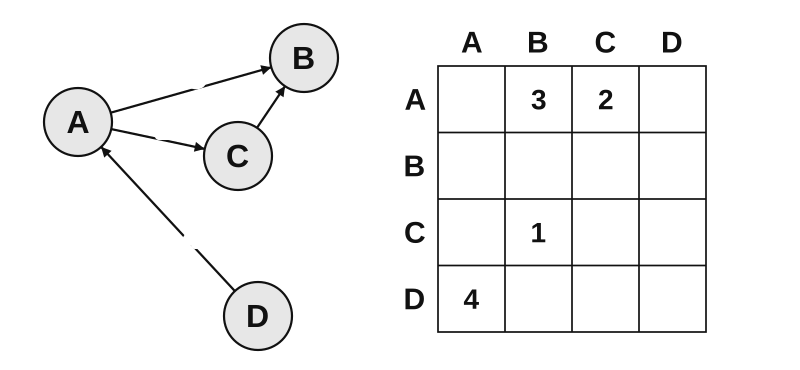
A Directed Weighted Graph alongside its Adjacency Matrix representation.
4. Comparison Summary
To summarize, choosing between these two graph implementations depends heavily on the properties of your data and the operations you need to perform frequently.
| Operation / Feature | Adjacency Matrix | Adjacency List |
|---|---|---|
| Space Complexity | O(V^2) |
O(V + E) |
| Add Edge | O(1) |
O(1) |
| Remove Edge | O(1) |
O(V) |
| Check Edge Exists (Query) | O(1) |
O(V) |
| Find all Neighbors | O(V) |
O(Degree of V) |
| Best Used For... | Dense Graphs | Sparse Graphs |
Note: Dense graphs are networks where the number of edges is close to the maximum possible number of edges (V^2). Sparse graphs have far fewer edges overall.
Exercise 1 of 2
?Which graph implementation is generally the most memory-efficient choice for a highly sparse graph?
Exercise 2 of 2
?What is the worst-case time complexity to check if an edge exists between two nodes in an Adjacency Matrix?