Greedy Algorithms
Greedy Algorithms in Data Structures and Algorithms
Key Takeaways: A Greedy Algorithm is an algorithmic paradigm that builds up a solution piece by piece. At every step, it chooses the most obvious and immediately beneficial option, without worrying about the future consequences.
Greedy Algorithms are intuitive, fast, and often straightforward to implement. While they don't always yield the globally optimal solution for every single type of problem, when they do, they are typically the most efficient approach available.
1. What is a Greedy Algorithm?
Imagine you are driving, and at every intersection, you take the road that looks the least congested right now. You don't look at a map to see if that road eventually leads to a massive traffic jam. You are just making the best local choice at that exact moment.
This is the absolute essence of a Greedy Algorithm.
It makes a locally optimal choice in the hope that these local choices will ultimately lead to a globally optimal solution.
The Two Core Properties
For a problem to be perfectly solvable using a Greedy Algorithm, it must exhibit two specific properties:
- Greedy Choice Property: A global optimum can be reached by selecting the local optimums. In other words, making the best choice now will never negatively impact the final outcome.
- Optimal Substructure: The optimal solution to the overall problem contains the optimal solutions to its smaller subproblems.
2. Visualizing a Greedy Approach (The Coin Change Problem)
The most relatable example of a Greedy Algorithm is giving change. Suppose you are a cashier and need to give a customer 41 cents in change. You have an infinite supply of standard US coins: Quarters (25¢), Dimes (10¢), Nickels (5¢), and Pennies (1¢).
Your goal is to give the change using the fewest number of coins possible.
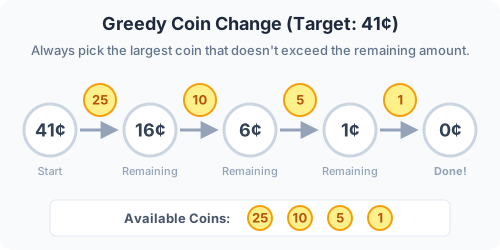
The Greedy Strategy Step-by-Step:
- Target: 41¢. The largest coin less than or equal to 41 is a Quarter (25¢). We greedily take it. (Remaining: 16¢)
- Target: 16¢. The largest coin less than or equal to 16 is a Dime (10¢). We take it. (Remaining: 6¢)
- Target: 6¢. The largest coin less than or equal to 6 is a Nickel (5¢). We take it. (Remaining: 1¢)
- Target: 1¢. The largest coin is a Penny (1¢). We take it. (Remaining: 0¢)
Result: 4 coins (25, 10, 5, 1). This is the exact optimal solution!
3. When Do Greedy Algorithms Fail?
Greedy algorithms are fantastic, but they can be shortsighted. Let's change the coin system to demonstrate this. Imagine a fictional currency with coins worth 1¢, 3¢, and 4¢. We need to make 6 cents of change.
- Greedy Approach: It greedily takes the largest coin first (4¢). The remaining is 2¢. It then takes two 1¢ coins. Total coins = 3 (4, 1, 1).
- Optimal Approach: Take two 3¢ coins. Total coins = 2 (3, 3).
Because the Greedy Algorithm cannot "look ahead" or reconsider its past choices, it gets stuck with a sub-optimal solution in this scenario. When a Greedy approach fails, we typically turn to Dynamic Programming to explore overlapping subproblems.
4. Greedy vs. Dynamic Programming
Since both paradigms deal with heavy optimization, they are frequently compared in technical interviews.
| Feature | Greedy Algorithm | Dynamic Programming (DP) |
|---|---|---|
| Strategy | Makes a local optimum choice at each step. | Explores all possible subproblems to find the global optimum. |
| Re-evaluation | Once a choice is made, it is never reconsidered. | Evaluates past choices and uses stored results (memoization). |
| Speed/Efficiency | Generally very fast, often O(N log N) or O(N). |
Can be slower and more memory-intensive due to state caching. |
| Guarantee | Does not guarantee an optimal solution for all problems. | Always guarantees an optimal solution if optimal substructure exists. |
5. Classic Greedy Algorithms
Despite their limitations in some scenarios, Greedy Algorithms perfectly solve many famous problems in Computer Science:
- Fractional Knapsack Problem: Unlike the 0/1 Knapsack, you can break items into fractions. The greedy choice is simply sorting items by value-to-weight ratio and taking the highest first!
- Dijkstra's Algorithm: Finds the shortest path in a graph from a single source by always picking the closest unvisited node.
- Kruskal's & Prim's Algorithms: Used to find the Minimum Spanning Tree (MST) of a graph by continually picking the smallest available edge.
- Huffman Coding: Used for data compression by assigning variable-length codes based on the frequency of characters, greedily merging the least frequent characters first.
6. Python Implementation
Let's implement the Fractional Knapsack Problem. We have a set of items with weights and values, and a knapsack with a maximum capacity. We want to maximize the total value, and we are allowed to take fractions of an item.
Fractional Knapsack (Greedy Approach in Python)
class Item: def __init__(self, value, weight): self.value = value self.weight = weight # Calculate the value-to-weight ratio self.ratio = value / weightdef fractional_knapsack(capacity, items): # Sort items based on ratio in descending order (Greedy Choice) items.sort(key=lambda x: x.ratio, reverse=True) total_value = 0.0 for item in items: if capacity >= item.weight: # If the knapsack can hold the entire item, take it all capacity -= item.weight total_value += item.value else: # If it can't hold the entire item, take the remaining fractional part fraction = capacity / item.weight total_value += item.value * fraction capacity = 0 # Knapsack is now full break # We are done return total_value
# Define our items: Item(value, weight) items = [Item(60, 10), Item(100, 20), Item(120, 30)] max_capacity = 50
max_profit = fractional_knapsack(max_capacity, items) print(f"The Maximum profit is: ${max_profit}")
Breaking Down the Code:
- Ratio Calculation: We calculate the
value / weightratio for every single item. This tells us the "density" of value. - Sorting: We sort the items descending by their ratio. This is our greedy approach: always prioritize the item that offers the most value per kg.
- Iteration: We iterate through the sorted list. If we have enough capacity, we take the whole item. If not, we take exactly the fraction needed to fill the bag, add that partial value, and then we terminate.
Exercise
?What is the primary characteristic of a Greedy Algorithm?