0/1 Knapsack Problem
0/1 Knapsack Problem in Dynamic Programming
Key Takeaways: The 0/1 Knapsack Problem is a classic Dynamic Programming problem. It teaches us how to maximize the total value of items placed in a bag with a strict weight limit, where items cannot be broken into smaller fractions (you either take an item entirely, or leave it).
The 0/1 Knapsack Problem is one of the most famous optimization problems in Computer Science. It perfectly illustrates the power of Dynamic Programming and is a frequent topic in top-tier technical interviews.
1. What is the 0/1 Knapsack Problem?
Imagine you are a thief who has broken into a jewelry store. You have a single knapsack (a bag) that can carry a maximum weight of W.
In the store, there are n items. Each item has:
- A specific weight (
wt). - A specific value (
val).
Your goal is to steal the optimal combination of items to maximize your total profit, without exceeding the maximum weight limit W of your knapsack.
The "0/1" in the name means you have only two choices for every item:
1(Take it): You put the entire item in your bag.0(Leave it): You leave the item behind.- You cannot break an item in half or take a fraction of it.
2. Visualizing the Problem
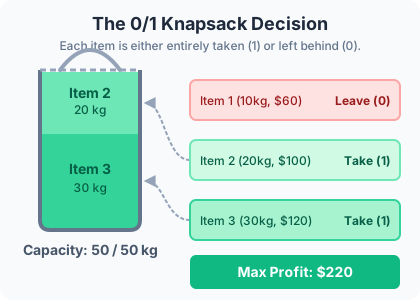
Let's look at a classic example. Your knapsack can hold exactly 50 kg. There are three items available:
- Item 1: Weighs 10 kg, worth $60.
- Item 2: Weighs 20 kg, worth $100.
- Item 3: Weighs 30 kg, worth $120.
Calculating the possible combinations:
- Item 1 + Item 2: 10kg + 20kg = 30kg. Value: $160.
- Item 1 + Item 3: 10kg + 30kg = 40kg. Value: $180.
- Item 2 + Item 3: 20kg + 30kg = 50kg. Value: $220. (Optimal!)
- All Three: 10kg + 20kg + 30kg = 60kg. (Exceeds 50kg limit, INVALID)
The optimal solution is to take Item 2 and Item 3, achieving a total value of $220.
3. Approaches to Solving 0/1 Knapsack
There are several ways to approach this problem, starting from a naive solution to a highly optimized one.
Approach 1: Brute Force (Recursion)
The simplest way is to evaluate every single possible subset of items. For each item, we branch out into two possibilities: we either include the item in the knapsack, or we exclude it.
- Time Complexity:
O(2^n)because we make 2 recursive calls for every item. - Why it fails: For 50 items, the computer would have to calculate
1,125,899,906,842,624combinations. It is completely unscalable!
Approach 2: Top-Down Dynamic Programming (Memoization)
In the brute force approach, we end up recalculating the same subproblems repeatedly. We can use a 2D array (cache) to store the results of subproblems as we compute them.
- Time Complexity:
O(n * W) - Space Complexity:
O(n * W)for the cache +O(n)for the recursive call stack.
Approach 3: Bottom-Up Dynamic Programming (Tabulation)
This is the industry standard. We build a 2D array from the ground up, avoiding the overhead of deep recursive calls entirely.
4. Understanding Tabulation (The DP Table)
Let's build a DP Table dp[i][w] where:
irepresents the number of items considered so far.wrepresents the current maximum weight capacity of the knapsack.- The value inside
dp[i][w]represents the maximum profit we can achieve.
The Core Logic:
For each item i and each weight capacity w, we ask:
- Is this item heavier than my current capacity
w?- If yes, I can't take it. My max profit is the same as it was without this item:
dp[i-1][w].
- If yes, I can't take it. My max profit is the same as it was without this item:
- If I have enough capacity to take it, should I?
- We compare two scenarios:
- Scenario A: I take the item. My profit is
Item_Value + Profit_of_Remaining_Weight. (val[i-1] + dp[i-1][w-wt[i-1]]) - Scenario B: I leave the item. My profit is
dp[i-1][w].
- Scenario A: I take the item. My profit is
- We simply choose the maximum of Scenario A and Scenario B!
- We compare two scenarios:
5. Python Implementation
Here is the highly optimized Bottom-Up Dynamic Programming approach written in Python.
0/1 Knapsack Bottom-Up DP (Python)
def knapsack(W, wt, val, n): # Create a 2D array filled with 0s. # Rows = n + 1 (items), Cols = W + 1 (weights) dp = [[0 for x in range(W + 1)] for x in range(n + 1)] # Build the DP table in a bottom-up manner for i in range(n + 1): for w in range(W + 1): # Base Case: 0 items or 0 weight capacity yields 0 profit if i == 0 or w == 0: dp[i][w] = 0 # If item weight is less than or equal to current capacity elif wt[i-1] <= w: # Max of: (Value of current item + Value of remaining weight) OR (Value without current item) dp[i][w] = max(val[i-1] + dp[i-1][w-wt[i-1]], dp[i-1][w]) # If item weight is greater than current capacity, we cannot take it else: dp[i][w] = dp[i-1][w] # The bottom-right cell contains the maximum profit return dp[n][W]# Given inputs from our visual example values = [60, 100, 120] weights = [10, 20, 30] max_weight = 50 n_items = len(values)
max_profit = knapsack(max_weight, weights, values, n_items) print(f"The Maximum profit is: ${max_profit}")
6. Time and Space Complexity
- Time Complexity:
O(N * W)whereNis the total number of items andWis the maximum capacity of the knapsack. The nestedforloops iterate strictlyNtimes andWtimes. - Space Complexity:
O(N * W). We require a 2D array of size(N+1) * (W+1)to store the intermediate subproblem results. (Note: Space complexity can be further optimized toO(W)using only a 1D array since we only ever look back at the previous row).
Exercise 1 of 2
?Why is this specific algorithmic variation called the "0/1" Knapsack problem?
Exercise 2 of 2
?What is the Time Complexity of the Dynamic Programming (Tabulation) solution for the 0/1 Knapsack Problem?