Hash Sets
Hash Sets
Key Takeaways: A Hash Set is exactly like a Hash Table, but it only stores Keys without any Values. Its main superpower is instantly preventing and removing duplicate items from a dataset.
In the previous tutorial, we learned about Hash Tables (Dictionaries). Hash Tables use a Key to look up a Value.
But what if you don't care about a "Value"? What if you only want to keep track of a list of items and make sure that list has no duplicates? That is where the Hash Set comes in!
1. What is a Hash Set?
A Hash Set is an unordered collection of unique items.
Under the hood, a Hash Set uses the exact same Hash Function magic as a Hash Table. The difference is that it only stores the Keys.
Real-Life Analogy
Think of a VIP Guest List at an exclusive club.
- Hash Table: "Who is sitting at Table 5?" (Looking up a Value based on a Key).
- Hash Set: "Is John on the guest list?" (Simply checking if the Key exists or not).
If John tries to add his name to the guest list a second time, the bouncer says, "You are already on the list!" and ignores him.
2. How it Filters Duplicates
Because a Hash Set uses a Hash Function, it instantly knows if an item already exists.
- You try to add
"Apple"to the Set. - The Hash Function calculates Index
0. Since Index0is empty, it adds"Apple". - Later, you try to add
"Apple"again. - The Hash Function calculates Index
0. It sees that"Apple"is already there! - The Hash Set quietly ignores the second
"Apple".
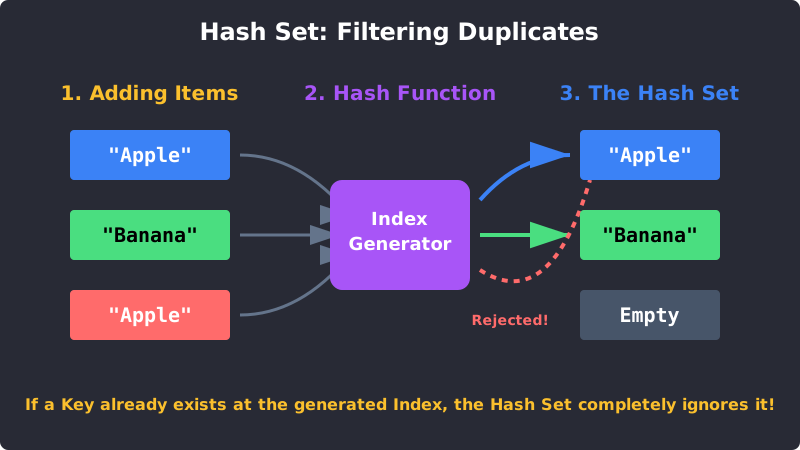
Hash Set: Duplicates are mathematically mapped to the same index and rejected.
3. When to Use a Hash Set
Hash Sets are the ultimate tool for specific algorithmic problems. You should use them when:
- You need to remove duplicates from an Array. (Just dump the Array into a Set, and the duplicates vanish!).
- You need to check if an item exists quickly. (Searching an Array takes
O(n)time, but searching a Set takesO(1)time). - You need to find the intersection of two lists. (Which users are in both Database A and Database B?).
4. Time Complexity
Because Hash Sets use Hash Functions, their speeds are identical to Hash Tables!
- Add / Insert:
O(1)Constant Time. - Remove / Delete:
O(1)Constant Time. - Check if Exists (Search):
O(1)Constant Time.
Warning: Because Hash Sets are based on mathematical hashing, they are unordered. If you print a Set, the items will not be in the order you added them!
5. Code Example (Python Sets)
Python has a built-in set data structure that is incredibly easy to use.
Let's write some code to see how it automatically destroys duplicate values!
Hash Sets in Python
# 1. Create an empty Set
vip_list = set()
# 2. ADD items (O(1) time)
vip_list.add("Alice")
vip_list.add("Bob")
print("Current List:", vip_list)
# 3. Try to add a duplicate!
vip_list.add("Alice")
# Alice is still only in there once!
print("After duplicate:", vip_list)
# 4. CHECK IF EXISTS (O(1) time)
if "Bob" in vip_list:
    print("Bob is allowed inside!")
else:
    print("Bob is not on the list.")
# 5. Magic Trick: Remove duplicates from a List instantly
messy_list = [1, 2, 2, 3, 3, 3, 4]
clean_list = list(set(messy_list))
print("Cleaned Array:", clean_list)
Exercise 1 of 1
?What happens if you try to add a value to a Hash Set that already exists inside it?