Linked List Operations
Linked List Operations
Key Takeaways: The true power of a Linked List lies in its operations. Inserting and Deleting elements is incredibly fast because you only need to update a couple of pointers. However, Searching is slow because you must walk through the list node by node.
Data structures are only useful if we can manipulate the data inside them.
In this tutorial, we will explore the three fundamental operations of a Linked List: Insertion, Deletion, and Traversal.
1. Insertion (Adding a Node)
Inserting a new node into a Linked List is extremely efficient. You don't have to shift any elements like you do in an Array!
There are three main places you can insert a node:
- At the Head (Beginning): Create the new node, point its
nextpointer to the current Head, and update the Head to be this new node. (Time Complexity:O(1)) - At the Tail (End): Traverse to the last node, and point its
nextpointer to the new node. (Time Complexity:O(n)if you don't keep track of the Tail). - In the Middle: Find the node just before where you want to insert. Point the new node's
nextto the rest of the list, then point the previous node'snextto the new node.
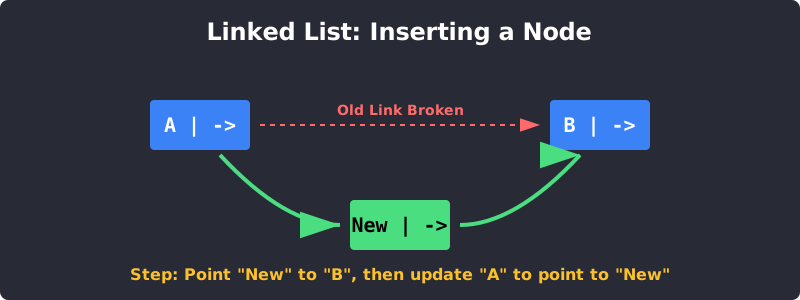
Inserting a Node: Break the old link and point to the new element.
2. Deletion (Removing a Node)
Deleting a node is just as easy as inserting one. The core concept is to bypass the node you want to delete.
If you want to delete Node Y (which is between Node X and Node Z):
- Traverse the list to find Node X (the node before the target).
- Change Node X's
nextpointer to point directly at Node Z. - Node Y is now completely disconnected from the chain! The computer's memory manager will automatically delete it (this is called Garbage Collection).
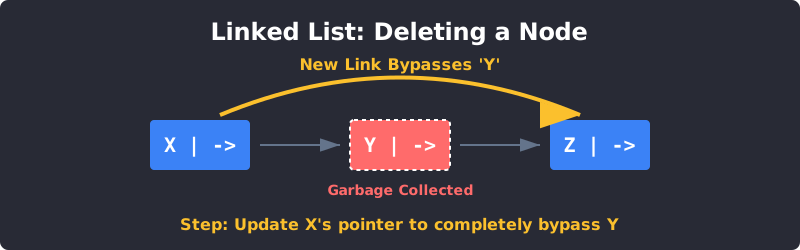
Deleting a Node: Update the previous pointer to bypass the target node.
3. Traversal and Searching
Traversal means "walking through" the Linked List.
To print every item, or to search for a specific value, you must start at the Head.
You then use a while loop to jump from one node to the next until you reach a node that points to NULL (the end of the list).
Because you have to check every node one-by-one, Traversal and Searching have an O(n) time complexity.
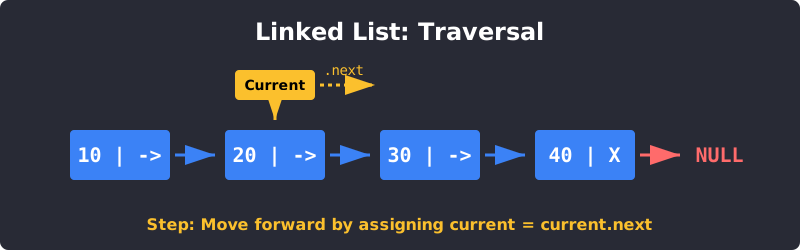
Traversal: A pointer moves step-by-step using current = current.next.
4. Code Example (Python)
Let's write out the logic for inserting at the front, deleting a specific value, and printing the list!
Linked List Operations
class Node: def __init__(self, data): self.data = data self.next = Noneclass LinkedList: def init(self): self.head = None # 1. INSERT at the beginning (O(1) time) def insert_at_head(self, data): new_node = Node(data) new_node.next = self.head self.head = new_node # 2. DELETE a specific value def delete_value(self, key): current = self.head # If the head itself holds the key if current is not None and current.data == key: self.head = current.next # Bypass the head return # Search for the key, keeping track of the previous node prev = None while current is not None and current.data != key: prev = current current = current.next # If the key was not present if current is None: return # Bypass the target node! prev.next = current.next # 3. TRAVERSE and Print def print_list(self): current = self.head while current is not None: print(current.data, end=" -> ") current = current.next print("NULL")
ll = LinkedList() ll.insert_at_head("C") ll.insert_at_head("B") ll.insert_at_head("A") print("Original List:") ll.print_list()
ll.delete_value("B") print("After deleting 'B':") ll.print_list()
Exercise 1 of 2
?What is the time complexity of inserting a new Node at the very beginning (Head) of a Linked List?
Exercise 2 of 2
?How do you conceptually delete a node from the middle of a Linked List?